Peak Season Phone Management for HVAC Contractors
Why Peak Season Breaks Most HVAC Phone Systems
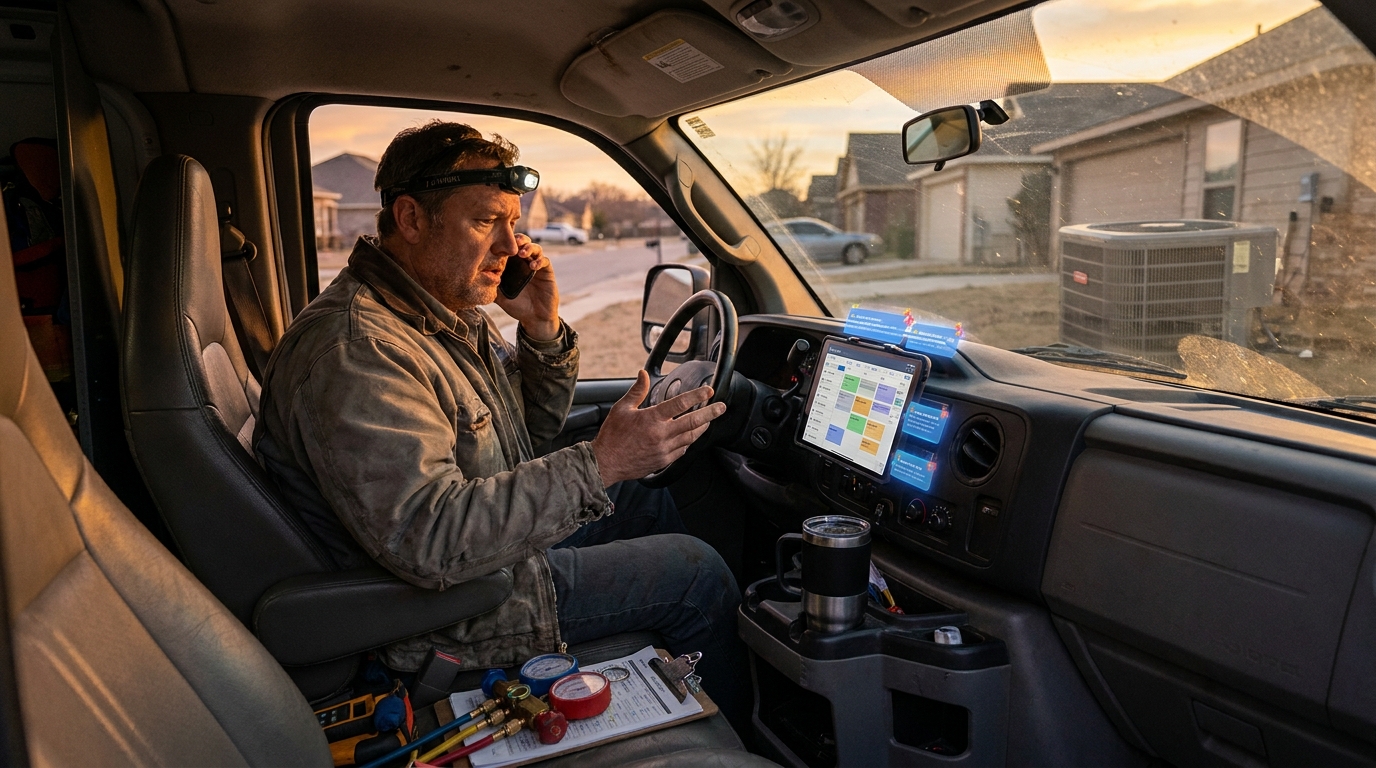
It's 97 degrees on a Tuesday in July. Your phone has rung 47 times since 8 AM. You're on a rooftop replacing a condenser. Your wife — who normally handles the office — is at the supply house picking up parts. By the time you climb down and check voicemail, you've got 12 missed calls and 4 messages. Three of those callers already booked with your competitor.
This is peak season. And for most HVAC contractors, it's the most profitable AND most chaotic time of year. The National Comfort Institute estimates that HVAC businesses generate 40-50% of their annual revenue between June and August. Miss the phones during those 12 weeks, and you're not just losing a $300 service call — you're losing the full-system replacement that was hiding behind it.
Here's the brutal math: the average HVAC service call is worth $385. A full system replacement averages $7,500. If you miss just 5 calls a day during a 90-day peak season, and 1 in 10 of those would have been a replacement, you've left roughly $337,500 on the table. That's not a typo.
Let's break down how to actually handle peak season phone volume without burning out, hiring expensive staff, or losing jobs.
The Real Cost of a Missed Call in July
Most contractors think of a missed call as a missed service ticket. That's wrong. A missed call during peak season costs you:
- The immediate job ($150-$500 average ticket)
- The follow-up replacement opportunity ($5,000-$15,000)
- The maintenance contract ($200-$400/year recurring)
- The referral pipeline (happy customers refer 2-3 neighbors on average)
- Your Google reputation (callers who can't reach you leave 1-star reviews)
And here's what most contractors don't realize — 85% of callers who can't reach you will NOT leave a voicemail. They'll hang up and dial the next company on Google. By the time you call back two hours later, that AC is already getting fixed by someone else.
The Four Phone Management Strategies (And Why Three Fail)
Strategy 1: Answer it yourself
This works in February. In July, it means you're either taking calls on the roof (dropping them, mishearing addresses, losing your concentration) or letting them go to voicemail. Most one-truck and two-truck operations hit a wall here by mid-June.Strategy 2: Hire a receptionist
A full-time office person runs $42,000-$55,000/year with payroll taxes and benefits. They work 40 hours a week, take lunch breaks, get sick, and go on vacation. They don't answer at 9 PM when a customer's AC dies during a heat wave. We did a full breakdown in AI vs Human Receptionist: Real Cost Comparison for Contractors.Strategy 3: Traditional answering service
They answer the phone, take a message, and text it to you. You still have to call the customer back, qualify them, check your schedule, and book the job. During peak season, that's 30+ callbacks a day on top of running calls. And they charge $1-$2 per minute, which during peak season can run $800-$1,500/month — for a service that doesn't actually book anything.Strategy 4: AI receptionist that books jobs automatically
This is the only strategy that scales with call volume. An AI answers every call instantly, qualifies the lead, checks your calendar, and books the job — without you doing anything. PickupBell does this for a flat $199/month, no matter if you get 50 calls or 500.Building a Peak Season Phone Playbook
Whether you use AI, a human, or a combination, you need a documented system before the heat hits. Here's what should be in your playbook:
1. Define your job qualification criteria
What counts as an emergency? What's your minimum service fee? Do you work on Carrier? Mitsubishi mini-splits? Geothermal? What's your service area radius? Write all of this down. If you're training an AI receptionist on your HVAC business, this is the first thing you'll need.2. Set your peak season pricing
Many contractors charge a peak-season diagnostic fee ($95-$149) or a same-day surcharge ($50-$100). Decide this in May, not July. Your phone answering system — human or AI — needs to communicate this clearly.Your Next Job Is One Missed Call Away.
PickupBell answers every call and books jobs directly on your calendar — 24/7, automatically. $199/month.
Start Free Trial3. Build emergency routing rules
When does a call get transferred to the on-call tech? Real emergency only (no cool air + elderly resident or infant in home), or anything the caller flags as urgent? Configure call transfer rules so emergencies reach you immediately but tire-kickers don't.4. Block the spam
During peak season, robocalls and spam calls explode — extended warranty scams, fake utility callbacks, junk leads. Spam calls waste enormous amounts of HVAC technician time. Make sure your answering solution filters spam automatically.5. Set up automatic calendar booking
This is the make-or-break piece. If your system can't see your calendar and book the slot, you're back to manual callbacks. PickupBell integrates directly with ServiceTitan, Jobber, Housecall Pro, and other field service CRMs — the AI books the job on your real calendar in real time.How AI Handles the Peak Season Surge
Here's what a typical July day looks like with an AI receptionist running your phones:
- 6:45 AM — First call comes in. Customer's AC died overnight. AI answers in one ring, qualifies the issue, checks the calendar, books a 10 AM slot, sends a confirmation text.
- 9:15 AM — Three calls come in at the same time while you're under a house. AI answers all three simultaneously. Two get booked for tomorrow, one gets routed to you because it's a no-cool with an infant in the home.
- 2:30 PM — Spam call from a fake "home warranty" company. AI blocks it. You never know it happened.
- 7:45 PM — After-hours call. AI takes the request, schedules a first-thing-tomorrow appointment, and sends you a call summary so you walk into the day already briefed.
Contractors using PickupBell during peak season typically see a 25-35% increase in booked jobs compared to the prior summer — not because they're getting more calls, but because they're capturing the ones they were already missing.
Preparing Your Business Before the Rush Hits
If you're reading this in April or May, you have time. If you're reading this in late June, you're already behind. Either way, here's the prep checklist:
A system like PickupBell takes about 15 minutes to set up — see how it works — and at $199/month flat, it pays for itself the first time it books one extra job.
Key Takeaways
- HVAC contractors generate 40-50% of annual revenue in June, July, and August — missed calls during this window cost 8-12x more than off-season missed calls
- 85% of callers don't leave voicemails; they dial the next contractor on Google immediately
- Hiring a full-time receptionist costs $42K-$55K/year and still doesn't cover nights, weekends, or simultaneous calls
- Traditional answering services take messages but don't book jobs — leaving you with hours of callbacks every night
- AI receptionists like PickupBell answer every call, qualify the lead, check your calendar, and book the job automatically for $199/month flat
- Build your peak season playbook in spring: qualification rules, pricing, emergency routing, spam blocking, and calendar integration
- Contractors using AI phone answering during peak season typically capture 25-35% more booked jobs than the previous summer